
The Gram-negative bacterium Helicobacter pylori is a common human pathogen that infects at least 50% of the human population. Although H. pylori infections are usually asymptomatic, chronic inflammation occurs in most cases. Consequently, in 10% of cases an untreated infection can lead to the formation of gastric or duodenal ulcers, and even stomach cancer. H. pylori inhabits the gastric mucosa; some bacteria adhere at the intercellular junctions, damage these junctions and migrate across the epithelium. The results of studies published in recent years indicate that the HtrA protein secreted by these bacteria plays a key role in the process of transmigration of H. pylori across the epithelium. HtrA is an evolutionarily preserved serine protease, whose homologues in other bacterial species play important „housekeeping” functions, consisting in the removal of incorrectly folded proteins, which arise especially under stressful conditions. The studies conducted so far have focused almost exclusively on the characterization of the extracellular fraction of this protein. The in-depth understanding of the role of HtrA in the H. pylori cell physiology and virulence of this bacterium were hampered by the lack of strains deprived a functional htrA gene. In order to fill this knowledge gap, this project pursued the following objectives: (1) sequencing of the H. pylori genomes in search of mutations that would suppress the negative effects of HtrA deficiency; (2) investigating the effects of a lack of the HtrA function on the proteome of the H. pylori cells; (3) identification of proteins interacting with HtrA; (4) study of the phenotypic effects of the HtrA function deficiency in the H. pylori cells.
Using the mutant strains of H. pylori ΔhtrA (lacking the gene encoding the HtrA protein) and H. pylori htrAS221A, which produces HtrA proteolytically inactive but retains chaperone activity, obtained for the purposes of this project, we have shown that removal of the functional htrA gene from the H. pylori cells is associated with presence of additional mutations in the secA gene. This gene codes for a key enzyme, SecA, involved in the export of proteins from the cytoplasm. It can therefore be assumed that at least one of the functions of HtrA is related to the maturation and /or folding of the exported proteins. The results of further studies indicated that HtrA may be involved in transport and /or folding of certain outer membrane proteins, as well as proteins associated with the transport of metal ions (mainly nickel and iron ions). This is evidenced by the altered levels of these proteins in the htrA mutants and the fact of their interaction with the HtrA protein. The altered composition of the outer membrane may disrupt the functioning of the cell membrane as a barrier and increase the sensitivity to stress factors, while abnormal levels of the metal ion transport proteins may adversely affect the activity of many enzymes which use these ions as cofactors. As expected, the lack of functions played by HtrA resulted in an increased susceptibility of bacteria to most of the stress factors studied. Moreover, H. pylori lacking proteolytically active HtrA was not able to induce significant damage to the epithelial cells junctions in the in vitro tests.
The knowledge obtained as a result of the implementation of this project, apart from its unquestionable cognitive value in the field of the H. pylori cell physiology, should facilitate design of the anti-HtrA inhibitors as antimicrobial compounds to combat H. pylori infections. A deep understanding of the HtrA functions, and especially its intracellular role, is essential for the development of an appropriate strategy to counteract the activation of defense mechanisms in bacterial population, which would allow survival without HtrA.
Publications:
- Zawilak-Pawlik, A., Zarzecka, U., Żyła-Uklejewicz, D., Lach, J., Strapagiel, D., Tegtmeyer, N., Böhm, M., Backert, S., Skorko-Glonek, J (2019) Establishment of serine protease htrA mutants in Helicobacter pylori is associated with secA, Sci. Rep., 9(1),11794 (IF=3.998; 5Y IF=4.576)
- Zarzecka, U., Modrak-Wójcik, , Figaj, D., Apanowicz, M., Lesner, A., Bzowska, A., Lipinska, B., Zawilak-Pawlik A., Backert, S., and Skorko-Glonek, J. (2019) Properties of the HtrA protease from bacterium Helicobacter pylori whose activity is indispensable for growth under stress conditions., Frontiers in Microbiology, 10(MAY),00961; (IF=4.236; 5Y IF=4.927)
- Zarzecka, U., Harrer, A., Zawilak-Pawlik, A., Skorko-Glonek, J., Backert, S. (2019) Chaperone activity of serine protease HtrA of Helicobacter pylori as a crucial survival factor under stress conditions. Cell Communication and Signaling 17(1),161; (IF=4.344)
- Zarzecka, U., Grinzato, A., Kandiah, E., Cysewski, D., Berto, P., Skorko-Glonek, J., Zanotti, G., Backert, S. 2020. Functional analysis and cryo-electron microscopy of Campylobacter jejuni serine protease HtrA. Gut Microbes, Vol. 12, Issue: 1(IF=10,245; 5Y IF=12,117)
- Zarzecka, U., Matkowska, D., Backert, S., Skorko-Glonek, J. 2021. Importance of two PDZ domains for the proteolytic and chaperone activities of Helicobacter pylori serine protease HtrA. Cellular Microbiology, Vol. 23, Issue 4; Article number e13299; (IF=4,115; 5Y IF=4,715)
- Zarzecka U, Repetto O, Ambroziak P, Bielecka M, Czaplewska P, Mruk I, Musiał N, Figaj D, Roncarati D, Diechler S, De Re V, Wessler S, Godlewska R, Skorko-Glonek J. 2025. The function of the HtrA protease in maintaining homeostasis of the human pathogen Helicobacter pylori. Microb Pathog. Nov;208:107979. doi: 10.1016/j.micpath.2025.107979
Project funded by National Science Center UMO-2016/21/B/NZ2/01775; 2017-2021
 |
|
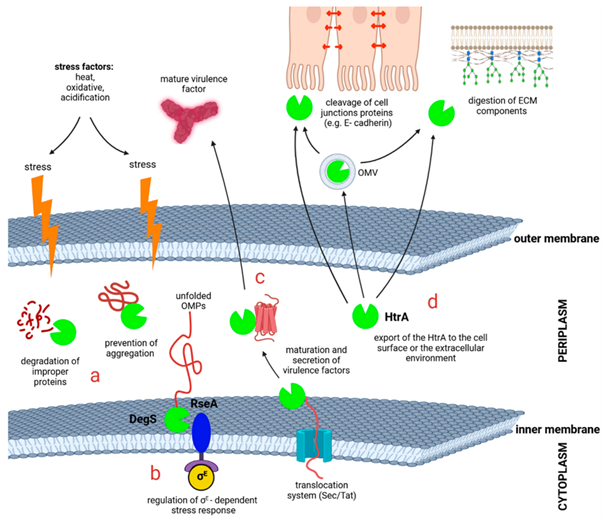
The role of the HtrA homologs in Gram-negative pathogenic bacteria. HtrAs are important in the various processes that are crucial for virulence and counteract the consequences of stress conditions. (a) HtrAs can function as protein quality control system components by digesting improperly folded proteins and preventing their aggregation. (b) Transcription of the σE-dependent genes requires digestion of the anti-sigma factor RseA. In response to the presence of unfolded OMPs, DegS becomes activated and cleaves RseA, and these events finally lead to the release of the transcriptional factor σE. (c) HtrAs are involved in secretion and proper maturation of several virulence factors. (d) HtrAs can be secreted outside the bacterial cell (on OMVs or by another hitherto unrecognized route). In the extracellular space, HtrAs act as virulence factors by cleavage of the cell junction proteins (E-cadherin, occludin, and claudin), or/and digestion of the extracellular matrix (ECM) components. From Zarzecka U. & Skorko-Glonek J. https://doi.org/10.3390/ijms252313182 |