
Objectives. In bacteria, the vast majority of proteins whose final destination is the cellular envelope, are transported through the cytoplasmic membrane (IM) via the Sec general secretory system. A nascent polypeptide designated for export is passed to SecA that translocates it across the SecYEG channel in the ATP-dependent manner. Then, the protein is released and folded at its final destination. No comprehensive studies on the Sec-dependent transport have been conducted in the human gastric pathogen, Helicobacter pylori. Considering that the export of several virulence factors is Sec dependent (including VacA – one of the two major H. pylori virulence factors), examination of this topic is essential to understand the mechanisms of pathogenicity of this bacterium.
Hypotheses. Basing on our unpublished results, we expect that in H. pylori, polypeptides translocated across the IM require assistance not only to reach the SecYEG translocon, but also at the stage of their release from the channel to the periplasm. To gain a proper structure and final destination, the Sec-dependent proteins require the coordinated action of several factors belonging to the extracytoplasmic protein quality control system (EPQCS), comprising periplasmic chaperones, folding catalysts and proteases.
A malfunction of any element can affect proteome of the envelope and consequently, virulence of bacteria.
The general aim of this study is to explore the functions of the EPQCS in the process of the post-translocational protein folding and possible cooperation with the Sec machinery in the bacterium H. pylori. That should lead to identification of a chaperone network that works together with Sec to ensure the extracytoplasmic proteostasis and efficient export of virulence factors.
The detailed aims include: (1) Identification of the Sec partners – components of EPQCS that affect translocation efficiency of Sec; (2) Characterization of the physiological effects of the EPQCS gene deletions and secA mutations; (3) Identification of periplasmic chaperone substrates; (4) Examination of the effects of the secA mutations and the selected EPQCS gene deletions on the H. pylori virulence.
National Science Centre of Poland: Grant NCN Opus20: UMO-2020/39/B/NZ2/00359
 |
|
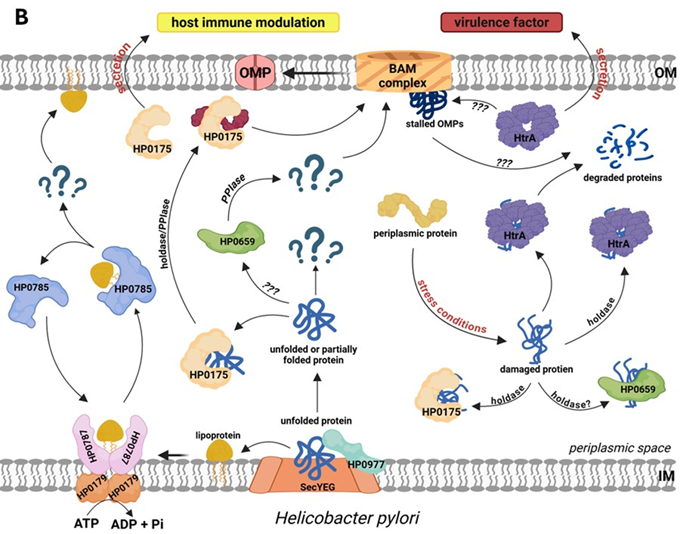
Protein folding, trafficking and quality control in the periplasm of Helicobacter pylori HP0179 (LolD) and HP0787 (LolF, a counterpart of E. coli LolC/E) mediate lipoprotein sorting. HP0785 (LolA) is a lipoprotein chaperone that transports lipoproteins destined for the OM; no LolB homolog was identified. Several classical periplasmic chaperones and proteases, including Skp, Spy, FkpA, BebA, and YcaL, are absent in H. pylori. SurA homologs are HP0175, which has PPIase and holdase activities and is secreted to modulate host immunity, and HP0659, a SurA homolog of unknown function. HP0977 is a PpiD homolog. The single DegP/DegQ homolog, HtrA, is a protease and holdase. In C. jejuni and H. pylori, certain fractions of HtrA are secreted extracellularly and act as virulence factors. Question marks indicate an unknown factor or function that has not been documented experimentally. |
Publications:
- Figaj D., Ambroziak P., Rzepka I.,Skórko-Glonek J., SurA-like and Skp-like proteins as important virulence determinants of the gram negative bacterial pathogens. International Journal of Molecular Sciences, 2023, vol. 24, nr 1, s.1-21, No. 295. DOI:10.3390/ijms24010295
- Godlewska R., Weltrowski M., Skórko-Glonek J., The Extracytoplasmic Protein Quality Control System in Pathogenic Campylobacterota: Its Role in Bacterial Virulence and Maintaining Cellular Envelope Proteostasis, International Journal of Molecular Sciences, 2025, vol. 26, nr 17, s.1-29, No. 8371. DOI:10.3390/ijms26178371
Conferences:
- Ambroziak Patrycja, Figaj Donata, Skórko-Glonek Joanna, Characterization of the SecA protein from bacterium Helicobacter pylori; the role of its C-terminal tail region, 2025, 1st International Conference on Advancements of Microbiology „The relevance of microbes in tackling threats to health and environment” 2025, Warsaw, Poland
- Patrycja Ambroziak, Donata Figaj, Anna Modrak Wójcik and Joanna Skórko-Glonek, Structural and functional properties of the Helicobacter pylori SecA protein. 16TH INTERNATIONAL WORKSHOP ON PATHOGENESIS AND HOST RESPONSE IN HELICOBACTERINFECTIONS” Helsingør, Denmark July 1st – 4th, 2026.
- Mateusz Weltrowski, Urszula Zarzecka, Patrycja Ambroziak, Hüseyin Korkmaz, Weronika Ścibek-Rejmontowska, Paulina Czaplewska, Joanna Skórko-Glonek. Silent Guardians of the Periplasm? Deciphering the Roles of HP0175 and HP0659 in Helicobacter pylori. 16TH INTERNATIONAL WORKSHOP ON PATHOGENESIS AND HOST RESPONSE IN HELICOBACTERINFECTIONS” Helsingør, Denmark July 1st – 4th, 2026.